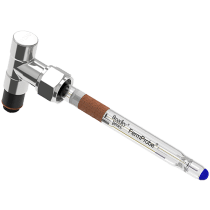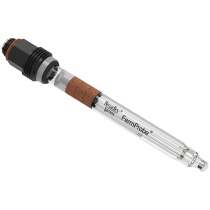
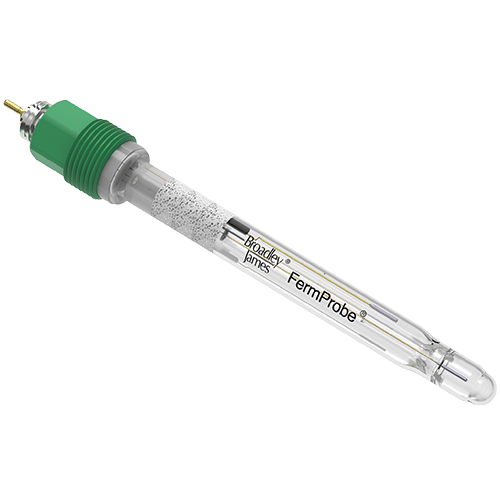
FermProbe®
ModelF-895

F-895 Autoclavable pH Sensor

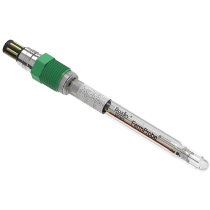
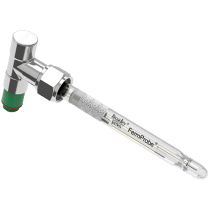
The new F-895 autoclavable pH sensor offers the same form, fit and function as the F-695 with improved performance and USP Class VI materials. The unique construction methods used by Broadley-James allows this pH sensor to exhibit virtually zero drift after autoclaving or steam sterilisation.

Ordering Information

Looking for a quote or to discuss your needs?

Our global team are on hand to help

Get a Quote

You can also review the documentation for technical details and purchasing information.

The F895 FermProbe® autoclavable pH sensor is built to withstand repeated high temperature sterilisation by pressurised steam. The Pg13.5 cap design provides for insertion and removal of the sensor from its sensor housing.

Each FermProbe is steam sterilized for one hour at 135°C before final QA tests in order to insure the highest level of sensor reliability.

All FermProbes have two built-in electrolyte chambers that act to protect and isolate the sensitive inner AgCl reference half-cell. This “double junction”, dual chamber design effectively prevents the most common failure modes of pH sensors in biopharmaceutical applications.

Features of the F-895 Autoclavable pH Sensor

  • Double-Junction Silver/Silver Chloride reference element for the ultimate in stability and resistance to contamination.
  • Specifically designed for multiple SIP, CIP, or Autoclave cycles. Withstands exposure to harsh CIP solutions.
  • Metric threaded cap is compatible with a wide range of bioprocess sensor housings.
  • Rugged, low-impedance pH bulb provides fast and precise pH measurements even after prolonged steam exposure.

Specifications

  • 0- 13 pH range
  • Steam sterilizable to 135° C
  • 150 psig max. pressure
  • Double junction, Ag-AgCl reference system
  • Metric Pg13.5 threaded disconnect cap

Sensor Housings

The F-895 pH Sensor has a metric Pg13.5 threaded polymer cap allowing it to be used with European style housings. We would recommend the following Broadley-James sensor housings for use with the Model F-895 FermProbe® autoclavable pH sensor:

Compatible Cables

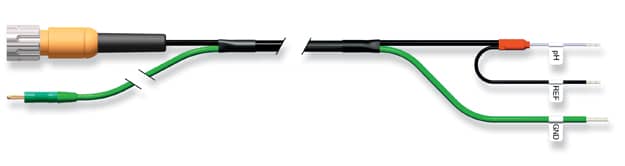
This FermProbe® style features a K9 detachable cable connection. We would recommend the following cables for use with the F-895 Autoclavable pH Sensor:

Cable Type Sensor Connector & Device Connector Device Terminal
KP plug to BNC, Type M k9_cable-bnc-small bnc-jack
KP plug to DIN, Type M k9_cable-din-small DIN-jack
KP plug to Ferrules, Solution Ground, Type N k9_cable-ferrule-z-small terminal-block


Choose Sensor Model

If the sensor needs to fit an existing cable, check cable connector. If it has a female connection, an F-695 or F-895 FermProbe is required. Another guideline is to note the connector’s color. If the cable connector is red or orange, use the F-695 or F-895 FermProbe.

Choose Sensor Length

Benchtop Applications

The sensor length is from the base of the cap to the tip of the sensor (the glass part of the sensor).

SIP Tank Applications

If you have already chosen a housing, select a sensor length with the same Class designation as the housing. The housing ordering information box also lists the correct sensor length to order. If you have not already chosen the housing, please review the recommendations next to each sensor model below.

Confirm Cable Length and Connector

Model F-895 pH sensors require disconnect cable and connector assemblies (see Accessories tab for information about compatible cables).

Ordering Information

Mode F-895 pH FermProbe with Standard Metric Cap

Sensor Model Use with these Housing Models Sensor Length Cable Length Connector Sensor Part Number
F-895 325, 335 Class D<1L Vessel 120 mm Order Separately (See Accessories Tab) F-895-B120-DK
F-895 325, 335 Class F1-3L Vessel 200 mm F-895-B200-DK
F-895 3L-5L Vessel 225 mm F-895-B225-DK
F-895 7L-15L Vessel 325 mm F-895-B325-DK
F-895 15L-20L Vessel 420 mm F-895-B420-DK
F-895 Many other lengths available, contact for information. XXX mm F-895-B480-DK

Note: the vessel sizes are for guidance only – check your own vessel dimensions or the length of the sensor you are replacing.