

Browse AllREDOX (ORP) SENSORS



REDOX (ORP) SENSORS FAQs
Why would I choose a longer sensor length?
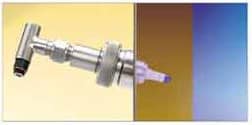
Sometimes the tank wall can become coated with a thick layer of viscous material that does not mix well with the rest of the media. If the pH sensing bulb of the sensor is located just a couple of inches inside the tank wall, the bulb might be smothered by this viscous layer. Subsequent pH readings may not be representative of the bulk of the media circulating in the rest of the tank. In the illustration at the right, the pH sensor's bulb is trapped in this slow moving viscous layer near the tank wall. The sensor is only measuring the pH of this layer.
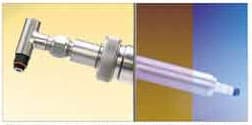
The solution to this problem described above is to choose a sensor and matching housing that extends further into the tank. This will position the pH sensing bulb away from the tank wall and place it closer to the circulating media further inside the tank. The subsequent pH measurements will be much more representative of the circulating media. In the illustration to the right, the sensor and housing protrude past the viscous zone and into the area of well stirred and circulated media within the production tank.
What is Redox / ORP?
The terms are interchangeable in meaning: Redox = Oxidation-Reduction Potential (ORP). The term Redox is more commonly used for bioprocess applications in Europe and the U.S. The term ORP is more commonly used for industrial chemical process applications in the U.S.
The redox potential of a media is related to the overall availability of electrons in the media, specifically the ratio of positive and negative ions in the solution. Note that redox measurements vary significantly with changing pH.
Why do you measure Redox in fermentation media?
The metabolic activity of microorganisms depends on many factors, including the redox potential of the culture environment. Measuring the redox potential allows the vessel operator to monitor the addition of reducing agents while ensuring that the potential is in the proper range for initiation of growth. It is also important to monitor the redox potential just before inoculation.
Anaerobic fermentation
Redox sensors are most commonly used to maintain anaerobic conditions in a culture media. They can be used to measure trace amounts (<1 ppm) of dissolved oxygen, at levels that are too low for D.O. sensors.
Downstream processing
Sometimes used in steps performed downstream of the fermentation process, redox sensors can monitor changes in concentration or the absence or presence of specific chemicals. Monitoring the redox potential is an effective way of tracking chemical conversions in the process.
Protein folding
The close regulation of redox potential is crucial to allow efficient formation of disulfide bonds, which facilitate folding and the stability of the folded protein. Overly oxidizing conditions can result in misfolding due to the formation of incorrect bonds.
Metabolic pathways
Measuring the redox potential is an effective way to determine its influence on the metabolic pathways of microorganisms. This is useful for substrate utilization or the production of specific metabolites
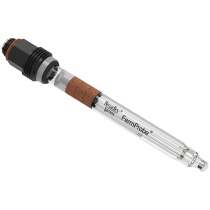
Specification for F-935 Redox FermProbe
- ± 5000 mV range
- Steam sterilizable to 135°C
- 150 psig maximum pressure
- Double junction, Ag-AgCl reference system
- Metric Pg13.5 threaded disconnect cap